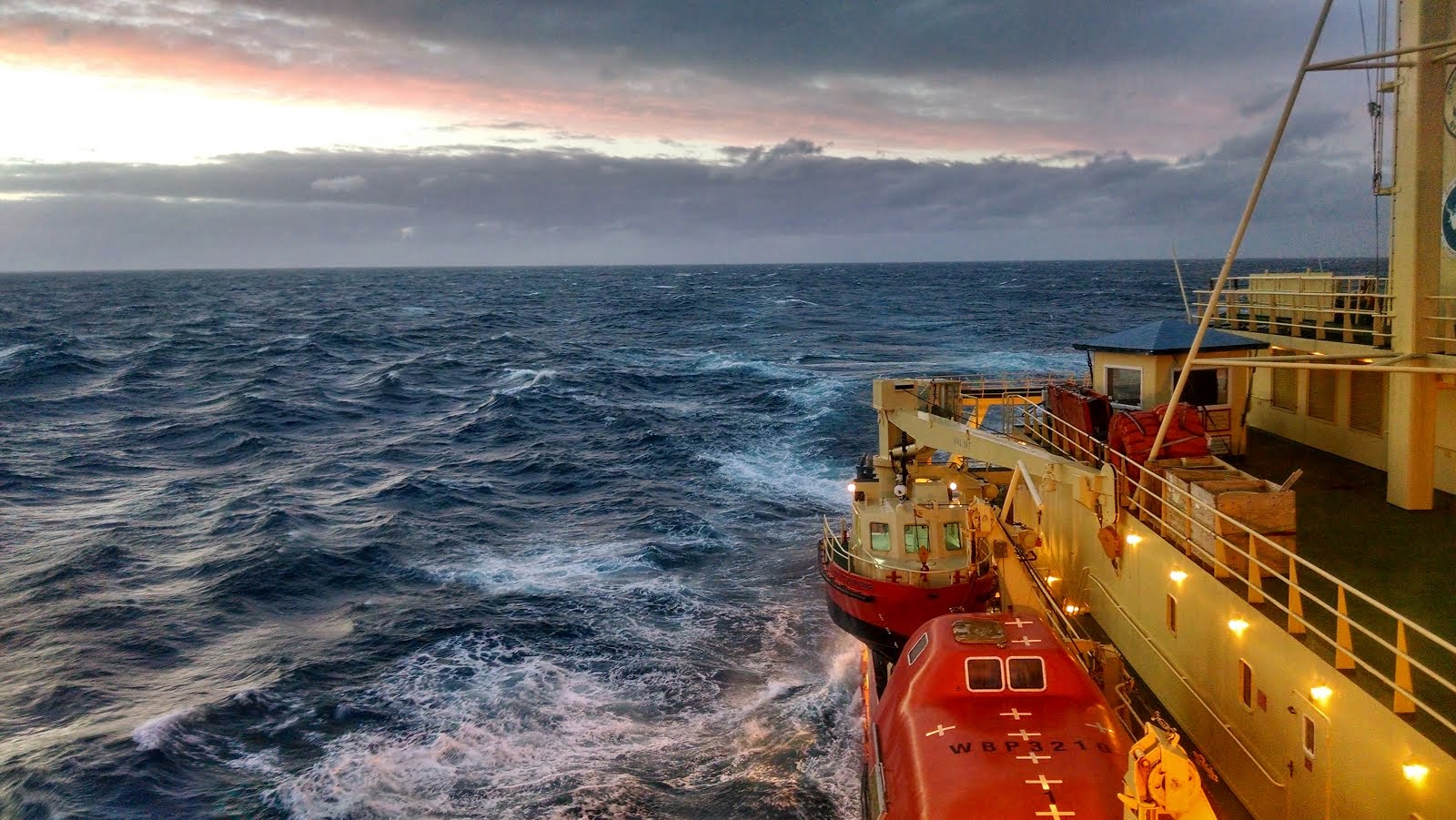
It's now two weeks since we left Hobart on the R/V Palmer. We crossed
the Antarctic Circle at 66.33°S to the start of the CLIVAR P16S line at
67°S, 150°W a few days ago. Now we are moving slowly northward along the
P16S line, sampling at stations up to four times a day, weather
permitting. So what is it that we are measuring in the ocean and how
are we measuring it?
What:
This cruise is part of a large international repeat hydrography program
(http://www.go-ship.org) that collects measurements along lines across
all of the global ocean basins, repeating the same lines every decade to
see how the ocean is changing. The P16S line was completed in 1991 and
again in 2005. We measure the physical and chemical properties in the
ocean from the surface to the bottom, and this global data is essential
for oceanographers to understand ocean circulation and the carbon cycle
and how it is changing over time. It is also very important to have
high quality ocean measurements to help calibrate sensors and to
validate and improve the performance of global climate models.
The second important role of this cruise is to deploy 12 autonomous
Argo (www.argo.net) profiling floats which drift along with ocean
currents below the ocean surface and come up to the surface every 10
days and send temperature, salinity and pressure data to satellites. We
are also deploying surface drifters that send their location to
satellites to measure currents and a team of NASA scientists is making
measurements of chlorophyll (an indication of how productive the water
is) to validate measurements of ocean color made by satellites.
How:
These sound pretty straightforward right? But it takes a whole team of
scientists, plus the crew members on board the ship many hours of
planning and hard work to collect all these measurements. The ship
operates 24 hours a day (ships are very expensive to run, so we use all
the time we can get!!) so everyone is assigned to a 12 hours shift. The
chief and co-chief scientists (Lynne Talley and Brendan Carter) are in
charge of all the science operations, and communicate with the ship's
Captain and the MPC (Main Point of Contact) to decide where and when the
ship will stop to take measurements.
All of the ocean measurements and water samples are collected using a
CTD (Conductivity, temperature and pressure) mounted on a rosette, which
has 36 bottles that can be closed at specified depths. The winch
operator supervised by the MT's (Marine Techs) lower the rosette into
the water, while members of the science team operate the CTD. This is
where I come in. I work as a CTD watchstander with 2 other graduate
students and our job is to prep the rosette before it goes into the
water, control collection of water samples while the CTD is in the water
and manage the sampling after the CTD is back on deck. When the rosette
is back on the ship, it's a race for water samples! There can be more
than a dozen different chemical properties being measured at a station
and so everyone is competing to collect water samples and it can get
very crowded and confused. One of the other CTD watchstander's or myself
acts as the Sample Cop, policing everyone to make sure they get water
from the right bottle in the right order. It can get very wet while
sampling and on many ships this happens outside on the deck where it can
be very cold. However, the Palmer is super fancy and designed for
working in polar conditions so the CTD is deployed and recovered from a
room with an enormous door so we are able to sample comfortably from
inside (although the sample water can still be below 0°C because the
salt in the water prevents it from freezing at that temperature!). All
the samples are taken to different labs on the ship, some inside the
ship and some on portable containers on the decks outside.
Finally, after the rosette is back on deck and we are leaving a station
we can deploy floats or drifters over the side of the ship. These are
(carefully) thrown overboard and are not recovered. The NASA team also
collects measurements with instruments deployed over the side and the
back deck.
BUT a research cruise is not all hard work! When we are waiting to
arrive at the next station, or the weather is too rough to do anything
we find ourselves with a LOT of spare time on our hands and not many
places to go. Next week I'll be writing about the many ways we spend our
time and keep ourselves entertained on the ship!
(Photos courtesy of Lynne Talley)
Wednesday, April 2, 2014
Tuesday, March 25, 2014
A tour of the RVIB Nathaniel B. Palmer
Well we are a week into our research cruise and well into the rough
seas of the Southern Ocean! We are now in the Antarctic Circumpolar
Current and have wave swells of 16-20 ft. and winds above 40 knots!
Today I am going to share with you some fun facts about the research
vessel, the Nathaniel B. Palmer and some of the ship's amazing
facilities.
Commissioned in 1992, the R/V Palmer was built by the US to maintain an
active and influential presence in scientific research in Antarctica. It
is ice-classed ABS-A2 which means the vessel is capable of breaking
three feet of level ice at three knots, allowing research to be done in
ice-covered regions that were not previously accessible. Science
programs are funded by the National Science Foundation's Office of Polar
Programs (NSF/OPP) and the ship is chartered by the Antarctic Support
Commission (ASC).
The essentials:
Builder: North American Shipbuilding, Larose, Louisiana
Installed Power: 1 2,720 Horsepower from four Caterpillar Diesels
Length: 94 m (308 ft.)
Width (Beam): 18.3 m (60 ft.)
Depth: 6.9 m (22.5 ft.)
Weight: 6,174 GT
Endurance: 75 days
Lab space: 7 labs, 5,600 sq. ft.
Accommodations: Science party: 43
Total capacity: 70
So you might be wondering who was Nathaniel Palmer? Nathaniel Brown
Palmer was an American seal hunter, explorer, merchant mariner and ship
builder who lived from 1799 to 1877. "Captain Nat" and his men were the
first to discover the Antarctic Peninsula and some historians credit him
with the discovery of the Antarctic continent.
Fun facts:
•The Palmer has completed over 80 research cruises
•During the Austral winter of 2003, the Palmer completed an
Antarctic-Arctic transit to complete its first Arctic Circle science
cruise from Barrow, Alaska
•The ship has a fuel capacity of more than 460,000 gallons.
•The Palmer can hold 7,200 gallons of helicopter fuel plus two
medium-sized helicopters (but there are none on the ship currently)!
•More than 3,000 steel plates were used to build the ship and the bow
plates (for breaking ice!) are 1 9/16" thick and twice as strong as
regular steel!
So what about the ship's interior? Well, there are several large
science labs, a computer lab, conference room, galley (for meals), movie
lounge (with fussball table!), gym, sauna (seriously!) and sleeping
quarters with a bunk bed and bathroom.
Stay tuned in the next few weeks to hear about the science operations
aboard the R/V Palmer and what we do for fun and to stay sane during
many long days at sea!
Wednesday, March 19, 2014
Welcome: Preparing for our research cruise!
Welcome to my CLIVAR P16S cruise blog! I'll be writing all about doing
science at sea and life on a US Antarctic Program icebreaker (The
Nathanial B. Palmer) over the next 50 days at sea.
I am a graduate student at Scripps Institution of Oceanography studying
the role of the Southern Ocean heat budget in global climate with Dr.
Lynne Talley who is the Chief Scientist (the Science boss!) for this
research cruise. My role on the ship is as a CTD watchstander (you'll
find out more about my job and other people's jobs at sea later on).
Today we set5 sail from Hobart, Tasmania but many months of planning
and preparation have gone into getting us here on the ship today. The
process starts many months before the cruise, with planning coordinated
between the chief scientist and the US Antarctic Program and CLIVAR to
decide when and where the ship will sail and what science programs will
be on board. Next is figuring out who will sail on the ship and making
sure all of the scientists meet the US Antarctic Program physical
requirements. This involves a lot of medical and dental tests to ensure
that everyone is fit and healthy because working on rough seas can be
quite physically demanding and when the ship is out in the Southern
Ocean we will be a loooong way from any kind of emergency assistance.
Another aspect of the cruise that required a huge amount of planning is
coordination and shipping of all the scientific equipment to the port in
Hobart. Remember that when you are at sea and something breaks there is
no Walmart on the ship to go and pick up a new part. So we have to make
sure we have every piece of equipment we could possibly need and at
least one spare of everything in case something breaks.
All of the gear was shipped to Hobart and a few days before departure
the science team arrived to work with the crew to load all of the
equipment. This involved carrying a lot of heavy boxes and playing some
Tetris to figure out where everything would fit on the ship and setting
up lab spaces. We may encounter very rough seas in the Southern Ocean,
so everything has to be very carefully secured for when the ship starts
rolling. Unless of course you want a new laptop and camera, in which
case you can just leave them on a work bench and see what happens!
The last few days were also the last chance for the crew and the
science team to be on dry land for a while so everyone took advantage of
the opportunity to be off the ship and explore beautiful Hobart and its
surroundings (including some amazing Platypus sightings!).
The preparation for the cruise is the long and boring part. Now we are
finally at sea the fun and excitement begins!
Subscribe to:
Posts (Atom)